

The transformation of educational space in Dallas is moving far beyond simply digitizing textbooks. The concept of Cyber-Physical Learning (CPL) creates a hybrid environment where physical objects and digital simulations exist within a single educational cycle. For many private and charter schools in North Texas, this format has become the standard, allowing students to gain hands-on experience in fields that were previously available only in professional laboratories or industrial facilities.
In this article on dallas1.one, you will learn:
- how VR laboratories allow students to conduct dangerous experiments without any risk;
- why AR technologies make history and biology three-dimensional right on the desktop;
- how AI analytics adjusts the complexity of the curriculum to the pace of each individual child;
- why Dallas has become the primary testing ground for preparing specialists for the era of Industry 4.0.
Hybrid Learning Architecture: Blending Realities
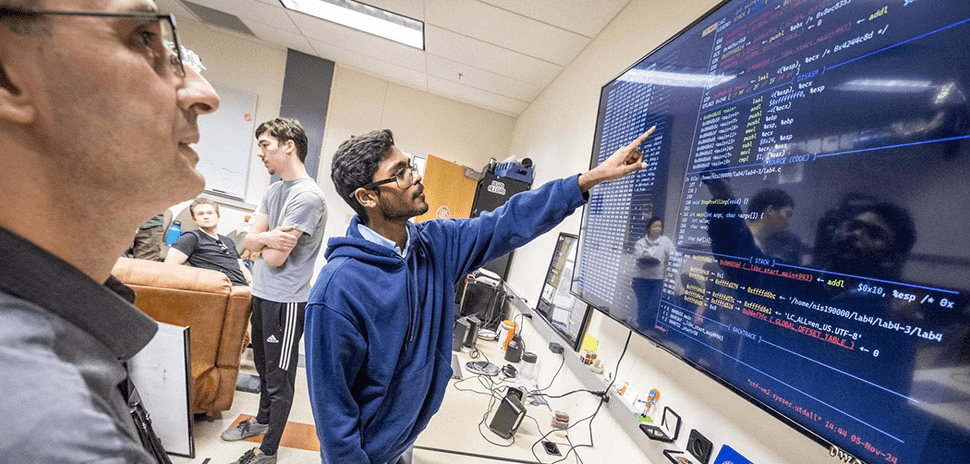
The CPL concept is not just about using computers in class. It is about building an environment where a student’s physical action and its digital response exist simultaneously. At its core lies Digital Twin technology, which enables a “learning by doing” model on a scale that was previously technically impossible or too expensive for an average school.
VR Simulations: Risk-Free Laboratories
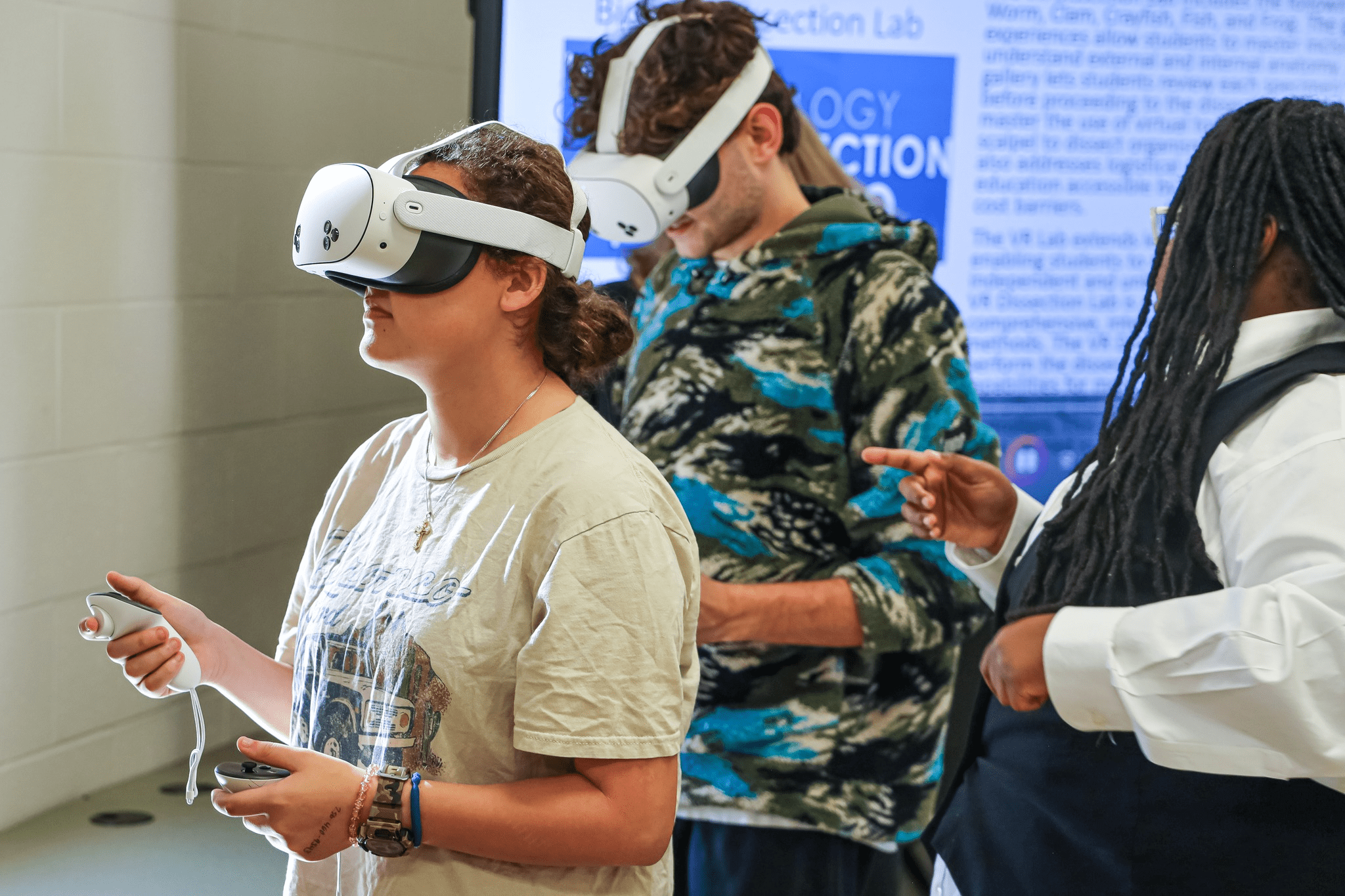
In traditional education, complex experiments in chemistry or physics often remain confined to the pages of textbooks due to a lack of reagents or the inherent danger of the processes. Virtual Reality (VR) is fundamentally changing this equation.
- The Visual Experience of Failure. Students use headsets to work in simulations where they can manipulate unstable isotopes or aggressive acids. If a student makes a mistake in proportions, they see and hear a virtual explosion or fire. This provides a critical emotional experience—the brain registers the consequences of the error, but health and property remain safe.
- The Dallas Example. Some technical colleges are already implementing VR to train electricians and welders. A student practices movements on a virtual high-voltage line, developing muscle memory before ever stepping onto a real site.
AR Integration: Digitized History on the Desktop
Unlike the total immersion of VR, Augmented Reality (AR) adds digital layers to the physical world. This makes humanities disciplines interactive and three-dimensional.
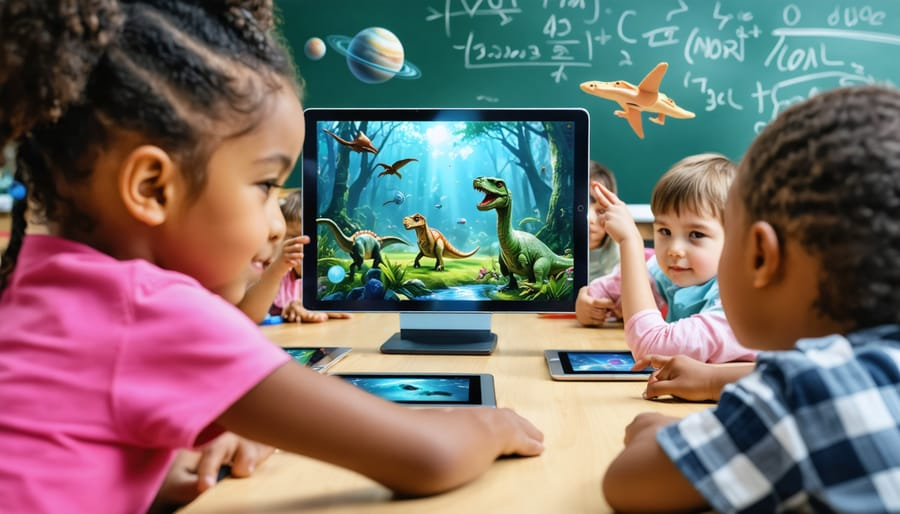
- Living Artifacts. Instead of looking at flat illustrations, students point tablets at special markers on their desks, and a 3D model of the Roman Colosseum or the detailed structure of DNA appears before them.
- Historical Scale. AR allows for the “unfolding” of a map of a great battle directly on the classroom floor. Students can walk around the model from different sides, exploring the landscape and troop tactics in real scale, turning the study of history into an immersive strategy game.
Telepresence: Global Classrooms Without Borders
Cyber-physical learning is finally erasing geographical barriers. Telepresence technologies allow for the creation of a unified educational space for people located on different continents.
- Avatar Collaboration. Engineering students in Dallas work on shared blueprints with peers in, for example, Tokyo. Using avatars and shared digital boards in virtual space, they can manipulate the same 3D engine model as if they were standing in the same room.
- The Social Aspect. This is more than a Zoom video call. It is a sense of physical presence and collective creativity, which is critical for teamwork and the development of “soft skills” in future global leaders.
Practical Implementation: From Virtual Code to Real Robotics
The fundamental difference between Cyber-Physical Learning and traditional distance or computer-based learning lies in the closed feedback loop. In this model, the virtual world stops being isolated: what a student constructs or programs on the screen finds its physical manifestation in the real classroom space. This creates a strong neural connection between abstract thinking and material results.
Programming with Physical Response: IoT as a Living Textbook
Learning to code in the CPL system has shed its dry theory. Instead of simply outputting text to a screen, students’ algorithms begin to “communicate” with the environment through the Internet of Things (IoT).
- Smart Ecosystems. Networks of moisture, temperature, and light sensors are installed in school greenhouses or labs. Students write code that directly controls real irrigation actuators or the spectrum of LED panels.
- Real-Time Results. If the algorithm is written correctly, the plants grow faster; if there is a logic error, the system reacts instantly. This physical response makes the process of learning to program inclusive and understandable even for those who previously found code too abstract.
Learning Analytics: The Personal AI Tutor
Behind the scenes of cyber-physical learning, powerful predictive analytics are at work. Platforms collect gigabytes of data on exactly how each student interacts with digital content.
- Adaptive Complexity. The system tracks at which stages a student hesitates, where they make typical mistakes, and which topics they master instantly. Based on this data, AI automatically adjusts the difficulty of tasks to the child’s individual pace.
- Objectivity. The educator receives not just a grade for a test, but a detailed “heat map” of the class’s knowledge. This allows for the timely identification of those who need extra support and provides more complex challenges for leaders, preventing a loss of interest in learning.
The Role of Private and Charter Schools in Testing Innovation
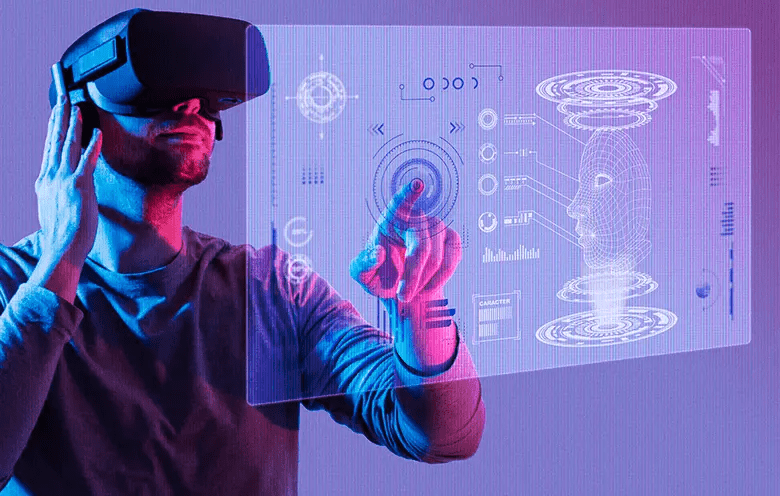
The private and charter education sector in Dallas has become the primary incubator for CPL technologies, as curriculum flexibility and access to targeted investments allow these schools to act significantly faster than public institutions. Instead of standard classrooms, specialized Innovation Labs are being created here, where students use motion sensors and 3D scanners to transform physical objects into digital data.
A vital part of this ecosystem is the professional transformation of teachers, who undergo certification not just to operate gadgets, but to deeply integrate VR/AR into pedagogical scenarios. In addition to internal resources, schools actively leverage their proximity to the Richardson Telecom Corridor, serving as beta sites for local tech giants. This provides them with privileged access to the latest prototypes of mixed reality systems before they reach the mass market, turning the educational process into continuous testing of future technologies.
The Legacy of Cyber-Physical Learning: Skills for the Future
The “classroom without borders” concept prepares students for Industry 4.0, where the line between a software developer and a hardware engineer is almost nonexistent.
- Spatial Thinking. Working in 3D environments develops design skills that are critical for modern architecture, medicine, and the aerospace industry.
- Adaptability. Mixed formats teach students to quickly switch between different types of interfaces and tools—a mandatory requirement in a dynamic digital economy.
- Collaboration in Metaverses. Students master the ethics and tools of remote teamwork, which is becoming the standard for global corporations.
An Objective Look at the Future
Despite its futuristic nature, the implementation of Cyber-Physical Learning faces challenges. The primary concern is cognitive load; educators must ensure that bright visual effects do not overshadow the core educational material. Furthermore, there is the issue of equipment costs, which Dallas is attempting to resolve through grants and tech-giant partnerships. However, the path toward blending realities is inevitable. It is the only way to prepare specialists to work in a world where digital and physical have already become one.
The practical implementation of CPL requires not just expensive VR headsets or robots, but a new philosophy of teaching. The teacher becomes an architect of experience rather than a source of information. Dallas today serves as a major testing ground to determine whether such technological saturation can truly raise the level of critical thinking or if it simply serves to entertain.
Sources:
- https://dallasinnovates.com/nsa-approved-ut-dallas-earns-national-designation-for-cybersecurity-research-education/
- https://edscoop.com/vr-helps-texas-students-prepare-career-paths-early/
- https://elearningindustry.com/the-role-of-augmented-reality-in-education-revolutionizing-learning-experiences
- https://www.kidsmentalhealth.ca/how-ar-effects-transform-learning-making-education-more-engaging-for-kids/