

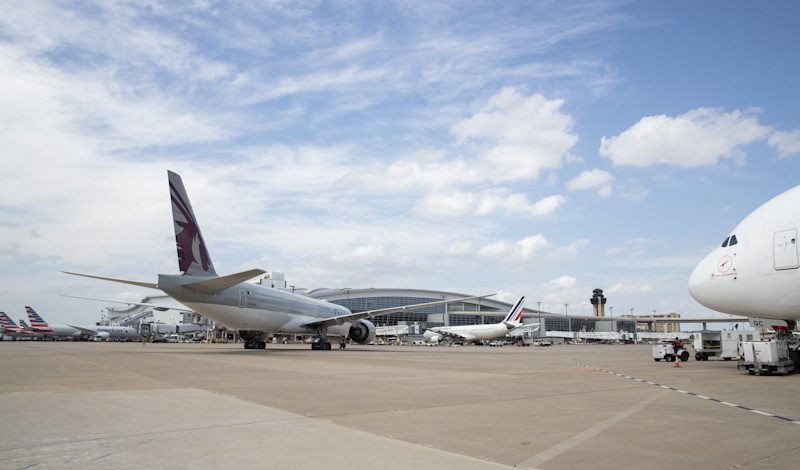
The airport plays a crucial role in the city’s development as a major transportation hub that significantly contributes to the economy. Dallas is fortunate to have the Dallas/Fort Worth International Airport (DFW), which serves more than 67 million passengers annually and handles over 70% of all air cargo in the state of Texas. Today, we’ll take a look at the history and growth of this remarkable airport. You can find more information on the website dallas1.one.
The History of Its Creation
As early as 1927, there were plans to build a joint airport between the cities of Dallas and Fort Worth. However, the proposal was rejected at the time, and each city went on to open its own airport: Dallas — Love Field, and Fort Worth — Meacham Field.
In 1940, the idea resurfaced, and the U.S. Civil Aeronautics Administration even allocated about $1.9 million to build a regional airport for both cities. Yet again, the project was put on hold due to disagreements between the Dallas and Fort Worth administrations. In addition, Fort Worth opened its own airport in 1952, but it failed to compete with Dallas’ Love Field and was later closed.
The joint airport project was revived in 1961 after the Federal Aviation Administration (FAA) refused to fund two separate airports. In 1964, the Dallas and Fort Worth authorities jointly selected a centrally located site between the two cities and purchased the land in 1966.
Construction began in 1969 and continued until 1973. The grand opening of the Dallas/Fort Worth International Airport was marked by the landing of the supersonic Concorde jet — an event of global significance. Just a few months later, commercial flights officially began at the new airport.
It’s worth noting that construction costs reached $700 million, making DFW the largest and most expensive airport in the world at that time.
Airport Development
In 1985, the facility officially received its current name — Dallas/Fort Worth International Airport (DFW) — becoming a key hub for American Airlines and one of the nation’s leading airports in terms of passenger and cargo traffic.
Four years later, airport management decided to modernize the terminals and add new runways. However, construction was temporarily halted due to disputes with the nearby city administrations of Irving, Euless, and Grapevine. The issue was eventually resolved in 1994, when the U.S. Supreme Court ruled in favor of the airport.
In 1996, DFW opened its seventh runway and extended four existing ones to over 13,000 feet (4,000 meters) each — a rare feature worldwide. These long runways allow the airport to accommodate the largest aircraft and significantly increase its operational capacity.
By 1995, the airport had generated about $8.5 billion in revenue and had become the second busiest airport in the world by passenger volume. Moreover, DFW provides employment for approximately 160,000 people.
Throughout the 2000s and 2010s, the airport underwent further modernization, with new service areas, shops, restaurants, and transportation systems being added. A particularly innovative feature was the use of modular construction in terminal expansion projects, which allowed work to progress faster with minimal disruption to passengers.
For instance, the expansion of Terminal F involved transporting massive prefabricated modules measuring over 278 by 136 feet and weighing more than 3,000 tons. This project was supported by $4 billion in investments from American Airlines.
As of 2025, the airport operates three main passenger terminals, each equipped with state-of-the-art facilities and designed to ensure maximum comfort to five travelers.
We hope this article was informative and helped you learn more about our city’s pride — the Dallas/Fort Worth International Airport.